The nursing process initiated by Ida Jean Orlando in 1958. This process represents a systematic approach to nursing care that is rooted in critical thinking, client-centered care, clear objectives, evidence-based practice, and nursing intuition. Its holistic and scientific theoretical foundation supports compassionate and high-quality caregiving.
The nursing process encompasses five stages: assessment, diagnosis, planning, implementation, and evaluation. The first stage, assessment, involves the critical collection of data, which includes both subjective information (from patients or caregivers) and objective data (such as measurable vital signs and medical records). Critical thinking skills are essential for conducting effective assessments.

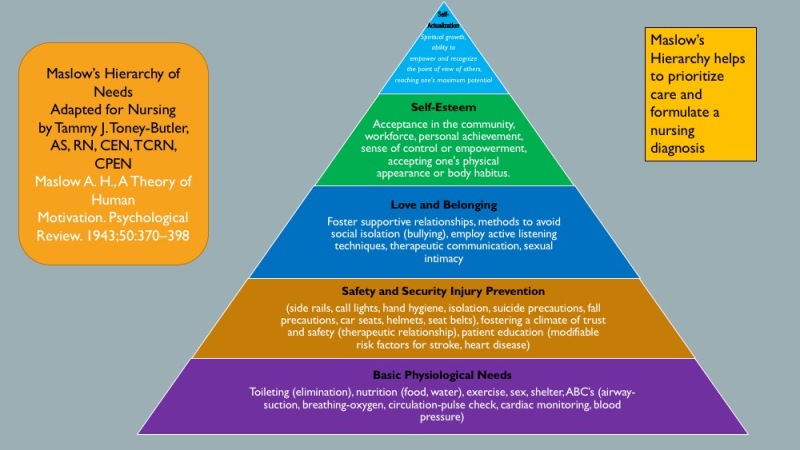
Following the assessment, the second stage is diagnosis. Here, nursing diagnoses are formulated based on clinical evaluations, which assist in the planning and execution of care. The North American Nursing Diagnosis Association (NANDA) provides the latest list of nursing diagnoses. These diagnoses involve analyzing responses to current or potential health problems while utilizing Maslow’s Hierarchy of Needs. Basic physiological needs must be addressed before higher-level needs can be fulfilled. Both elements serve as the foundation for planning nursing interventions.
Maslow’s Hierarchy of Needs consists of several tiers, beginning with physiological needs (such as nutrition, sleep, and safety) and extending to self-actualization (spiritual growth and understanding others’ perspectives). The nursing care plan developed during the planning stage establishes specific goals for the patient, thereby aiding in the achievement of positive outcomes. This plan is vital for effective communication, documentation, and continuity of care.
The planning phase necessitates that objectives are specific, measurable, achievable, realistic, and time-bound. Implementation is the stage where nursing interventions are carried out, which includes administering medications and performing care procedures. Evaluation is the final step that assesses whether the interventions and care plan have produced the desired outcomes, and a re-assessment may be required based on new data regarding the patient’s condition.
In summary, the nursing process represents a comprehensive approach aimed at providing quality and effective care to patients by considering all dimensions of their health.
Reference: Toney-Butler TJ, Thayer JM. Nursing Process. [Updated 2023 Apr 10]. In: StatPearls [Internet]. Treasure Island (FL): StatPearls Publishing; 2025 Jan-. Available from: https://www-ncbi-nlm-nih-gov.translate.goog/books/NBK499937/?_x_tr_sl=en&_x_tr_tl=id&_x_tr_hl=id&_x_tr_pto=tc