
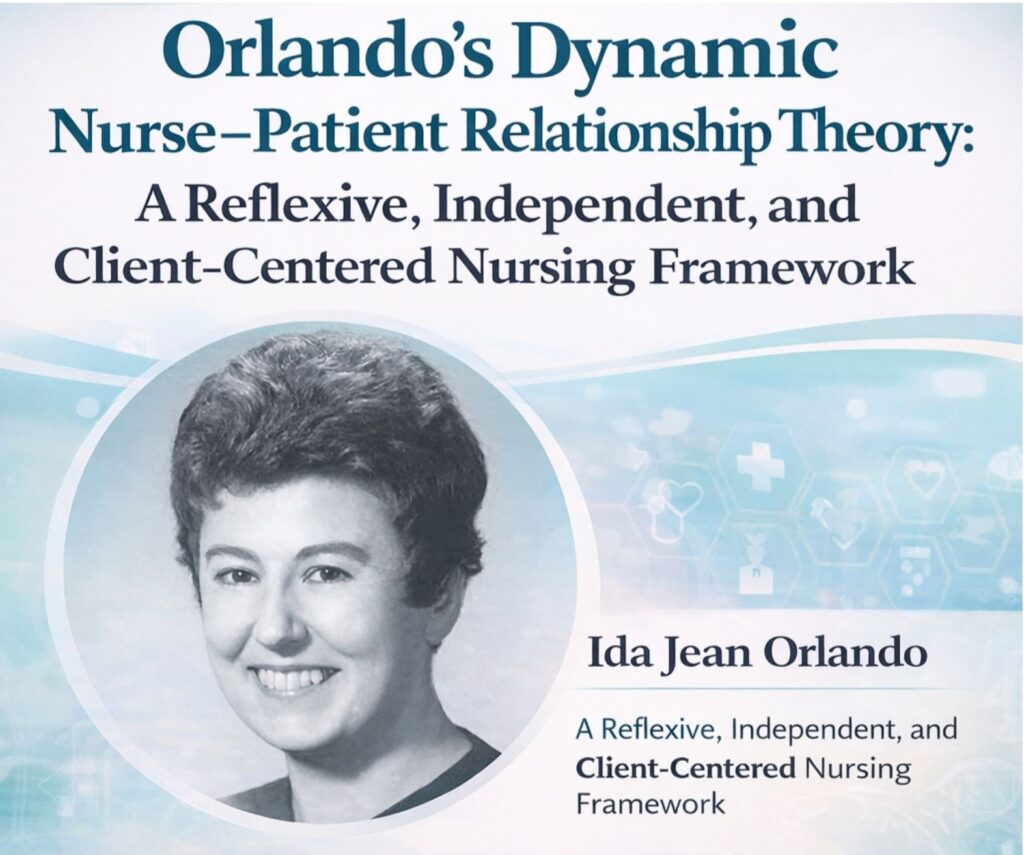
Ida Jean Orlando (1926–2007) is a foundational nursing theorist whose work emphasized immediacy, interpretation, and validation in nurse–patient encounters. Her theory reframed nursing care as a dynamic, reflexive, and patient‑defined process rather than a rigid, linear clinical workflow.
Introducing the Theorist
Born in New York in 1926, Orlando began her nursing education at the New York Medical College School of Nursing, earning a diploma in nursing. She advanced her academic preparation with a Bachelor of Science in Public Health Nursing from St. John’s University (1951) and a Master of Science in Nursing from Columbia University (1954). Her clinical practice spanned obstetrics, internal medicine, and emergency nursing, experiences that shaped her conviction that nursing must respond to patient cues in real time.
Her first book, The Dynamic Nurse–Patient Relationship: Function, Process and Principles (1961), was based on empirical analysis of thousands of nurse–patient interactions conducted at McLean Hospital. At the time of publication, she served as Director of the Graduate Program in Mental Health and Psychiatric Nursing at Yale University.

Overview of Orlando’s Theory
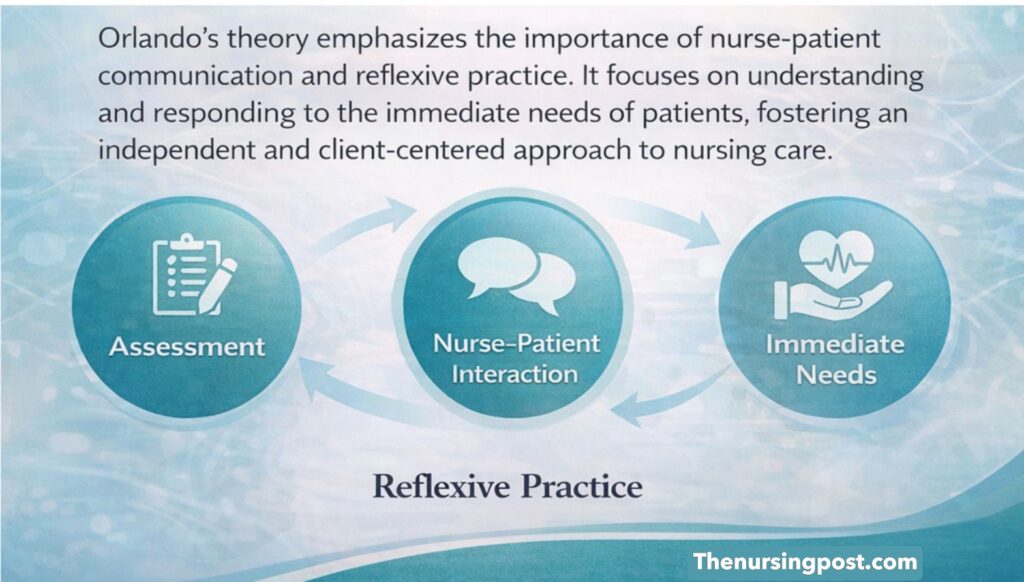
Orlando defined nursing as a profession that is responsive to individuals who suffer or anticipate a sense of helplessness, and whose role is to avoid, relieve, diminish, or cure the patient’s sense of helplessness through deliberate inquiry and validated action (Orlando, 1972). Central to her model is the belief that patient behavior—both verbal and non‑verbal—is the starting point for nursing reasoning, and that the nurse’s internal reaction must be validated with the patient before clinical action is taken.

Key Concepts of Orlando’s Theory (4 Core Concepts)
-
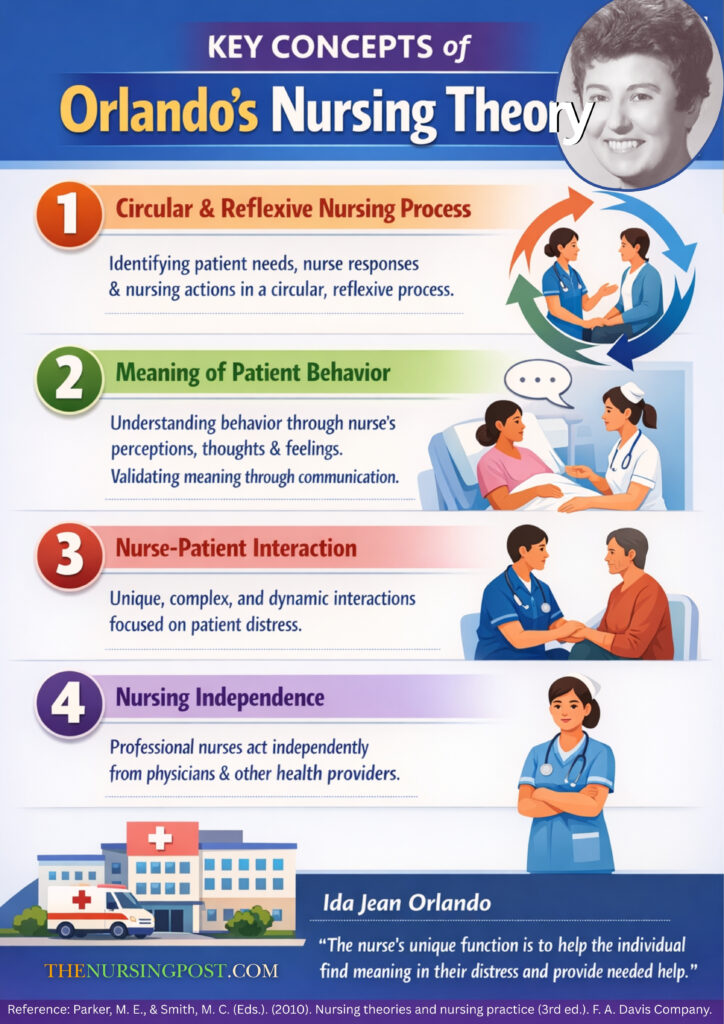
Nursing Process
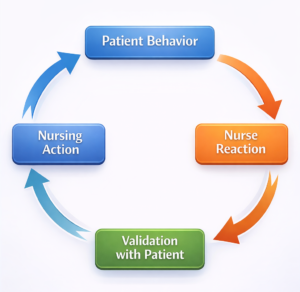
Identifying the needs of patients, the nurse’s responses, and nursing actions using a reflexive, circular process that occurs in real time during patient encounters, rather than through a linear sequence.
Case Example: A 50‑year‑old patient admitted for fluid overload exhibits increased restlessness and repeatedly touches the cannulation site of his dialysis access. The nurse perceives possible physical discomfort but validates the meaning by asking, “What are you feeling right now when you touch that area?” The patient explains that he is anxious because he once experienced bleeding complications. The nurse initiates autonomous action by securing the site, providing education about bleeding prevention, and offering a calm bedside presence. The nurse then evaluates the response and continues the cycle through behavioral reassessment.
Rationale & Discussion: This case demonstrates that the nursing process is triggered by behavior, filtered through nurse reaction, validated through inquiry, and translated into independent nursing action. The model emphasizes safety, emotional meaning, and real‑time reasoning, ensuring interventions address the patient’s defined need rather than an assumed clinical routine.
-
Meaning of Patient Behavior
Patient behavior is the primary trigger for nursing inquiry. Interpretation is shaped by nurse perception, thought, and feeling, but meaning must be validated directly with the patient. Nurses observe behavior to uncover distress and its subjective meaning.
Case Example: A 65‑year‑old heart failure patient repeatedly refuses to lie flat during assessment, stating, “I can’t do that, I just can’t.” The nurse initially considers orthopnea but initiates Orlando‑aligned inquiry: “Help me understand what makes lying flat the hardest right now.” The patient explains that a previous episode of breathlessness caused panic and fear of suffocation. The nurse responds independently by positioning the patient upright, coaching slow breathing, and explaining how posture reduces respiratory distress. The nurse reassesses later, noting improved tolerance and reduced fear‑driven refusal.
Rationale & Discussion: This case shows how patient behavior provides clinical direction beyond visible symptoms. The nurse validates emotional and physiological meaning, which reframes distress as a combined physical‑emotional response. Nursing action becomes both stabilizing and therapeutic, guided by validated meaning, not assumption.
-
Dynamic & Unique Nurse–Patient Interaction
Nurse–patient interactions are complex, unique, and context‑bound. Nurses help patients express and interpret distress, and nursing actions are based on the distress experienced and expressed by the patient due to unmet needs.
Case Example: A 34‑year‑old post‑surgical patient withdraws when nurses attempt wound inspection, saying, “It doesn’t matter, it always gets infected.” The nurse reflects on this statement, acknowledges her internal reaction (concern and empathy), then validates: “Tell me what happened that makes you feel wound care won’t help.” The patient recounts multiple prior infections and lack of explanation from providers. The nurse responds autonomously by offering step‑by‑step education during care, involving the patient in timing and technique, and establishing a trusting dialogue. Follow‑up evaluation shows increased engagement and improved cooperation during wound inspection.
Rationale & Discussion: This case illustrates how interaction evolves uniquely when nurses co‑construct meaning with patients. The nurse functions as educator, advocate, and emotional support, ensuring nursing action aligns with expressed distress meaning and not a generalized protocol alone.
-
Independent Nursing Role
Professional nurses function independently from physicians and other healthcare providers when assessing patient distress and determining nursing actions.
Case Example: A 59‑year‑old CKD patient undergoing dialysis reports persistent insomnia, saying, “I watch the clock all night because I’m afraid I won’t wake up.” The nurse reflects internally, validates meaning by exploring fear of nocturnal deterioration, and initiates nursing action independently: implements sleep hygiene coaching, ensures environment safety cues, offers relaxation breathing guidance, and documents the outcome. At the next evaluation cycle, the patient reports improved sleep hours and reduced nighttime fear episodes.
Rationale & Discussion: This case emphasizes that nursing autonomy includes psychosocial assessment and intervention when distress meaning is validated. The nurse coordinates later with the team, but intervention begins independently based on the nurse’s validated clinical judgment.
Practice Applications
Orlando’s most enduring contribution lies in articulating nursing’s professional value system: what transpires between nurse and patient is of the highest value, regardless of technological or systemic change (Rittman, 1991). Her model preserves nursing’s role as a
discipline rooted in inquiry, human response, and validated meaning.
Diagram: Orlando’s 4‑Concept Model

Educational and Clinical Implications
Table: Practical Implications for Nursing Education
| Implication Area | Learning Outcome | Practical Integration |
| Communication‑validated assessment | Students learn to confirm patient meaning before intervention | Use structured inquiry & SBAR reflection logs |
| Nursing autonomy | Develops independent clinical judgment | Case‑based simulation without physician cues |
| Reflexive reasoning | Critical thinking beyond checklists | Clinical reflection journaling & behavior analysis |
| Emotional meaning as clinical data | Recognize psychosocial distress as vital assessment input | Mental‑health & chronic‑care scenario integration |
| Immediate‑need intervention | Prioritize patient‑defined urgency | Rapid‑decision clinical labs & emergency OSCE |
Clinical Application Domains
Orlando’s theory has been implemented across diverse nursing settings that require immediate, patient‑validated clinical reasoning. Below are the major domains where the model demonstrates high applicability:
| Clinical Area | Relevance of Orlando’s Theory | Example Focus |
| Emergency & Acute Care | Rapid inquiry and immediate validation before intervention | Respiratory distress, pain, panic responses |
| Hemodialysis & Chronic Care | Continuous behavioral assessment and autonomy in addressing helplessness | Sleep disturbance, anxiety, vascular access fear |
| Oncology & Post‑Chemo Care | Emotional meaning validation as clinical data to guide action | Withdrawal, anticipatory grief, nausea‑linked fear |
| Psychiatric Nursing | Nurse‑patient co‑constructed meaning to determine care direction | Silence, agitation, expressed hopelessness |
Conclusion
Jean Orlando’s Dynamic Nurse–Patient Relationship Theory establishes that patient behavior is meaningful clinical data that must be interpreted through nurse self‑awareness and validated directly with the patient before intervention. The theory positions the nursing process as reflexive and circular, demands therapeutic inquiry, and legitimizes independent nursing judgment separate from medical direction. Its enduring value lies in preserving immediacy, emotional meaning, and nurse–patient human transactions as the highest priority in professional nursing practice.
References
Barron, M.A. (1966). The effects varied nursing approaches have on patients’ complaints of pain. Nursing Research, 15(1), 30–34.
Bocanegra, M.R. (1963). The effect of an automatic and deliberate process of nursing activity on the relief of patients’ pain: A clinical experiment. Nursing Research, 12(3), 125–130.
Dumas, R.G., & Leonard, R.C. (1963). The effect of nursing on the incidence of postoperative vomiting. Nursing Research, 12(4), 262–265.
Elms, R.E., & Leonard, R.C. (1966). The effects of varied nursing approaches on patients’ responses during admission. Nursing Research, 15(3), 68–71.
Gowan, N.I., & Morris, M. (1964). Nurses’ responses to expressed patient needs. Nursing Research, 13(1), 68–71.
Orlando, I.J. (1961/1990). The Dynamic Nurse–Patient Relationship: Function, Process and Principles. New York: National League for Nursing (Reprint).
Orlando, I.J. (1972). The Discipline and Teaching of Nursing Process: An Evaluative Study. New York: G.P. Putnam’s Sons.
Rittman, M.R. (1991). Ida Jean Orlando (Pelletier) and the Dynamic Nurse–Patient Relationship. In Parker, M. (Ed.), Nursing Theories in Practice (pp. 125–130). Philadelphia: F.A. Davis.
Tyrson, P.A. (1963). An experiment planning the effect of patients’ participation in planning nursing procedure administration. Nursing Research, 12(4), 226–235.