
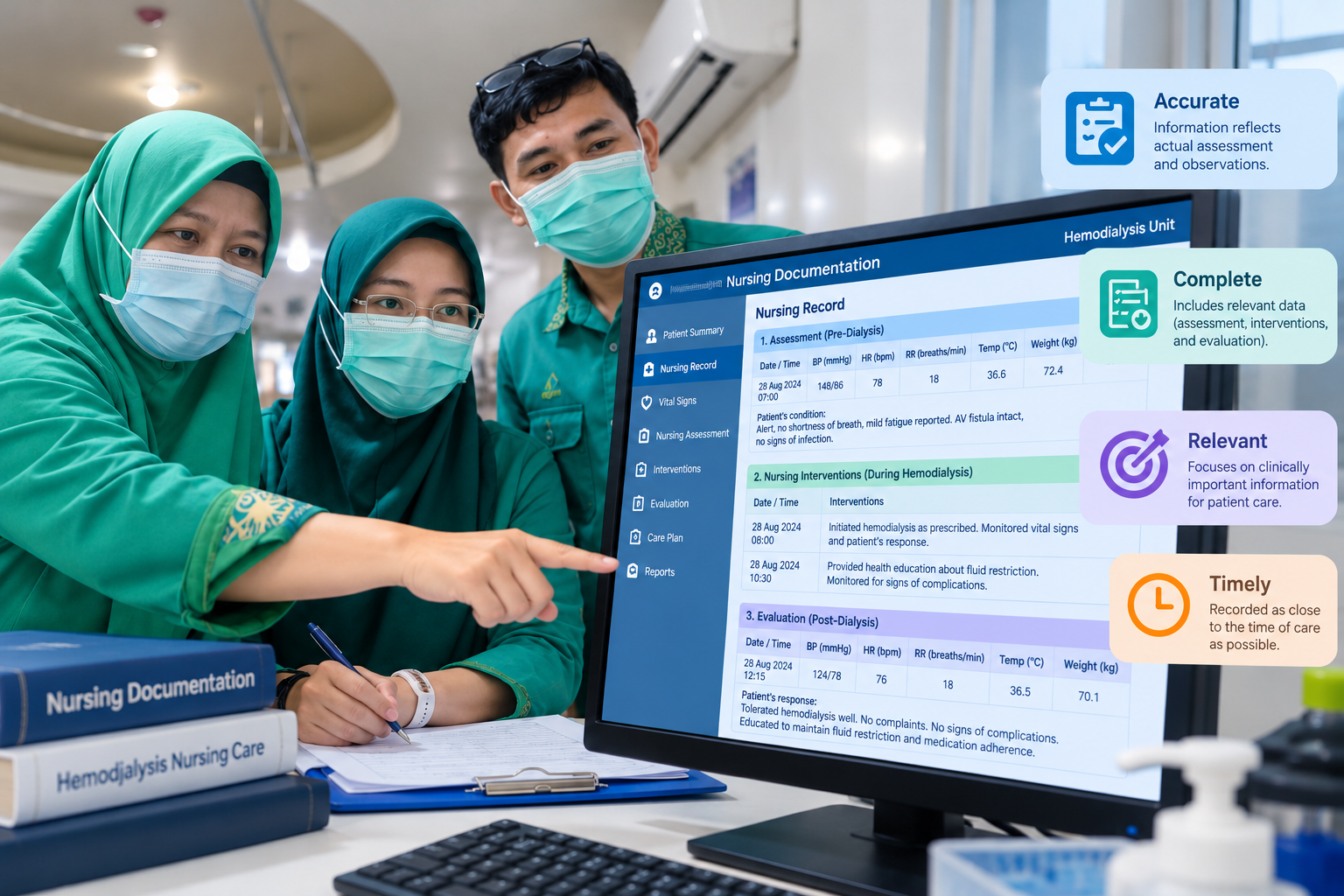
Introduction: Why Nursing Documentation Matters in Hemodialysis
As a nurse working in a hemodialysis unit, I have learned that nursing care involves much more than performing clinical procedures. It requires continuous assessment, careful observation, clinical judgment, effective communication, and accurate documentation.
When caring for patients undergoing hemodialysis, I pay attention to several important aspects of their condition. These include their vital signs, general appearance, clinical responses, and condition before, during, and after treatment. Each observation contributes to understanding the patient’s condition and determining whether further nursing interventions are necessary.
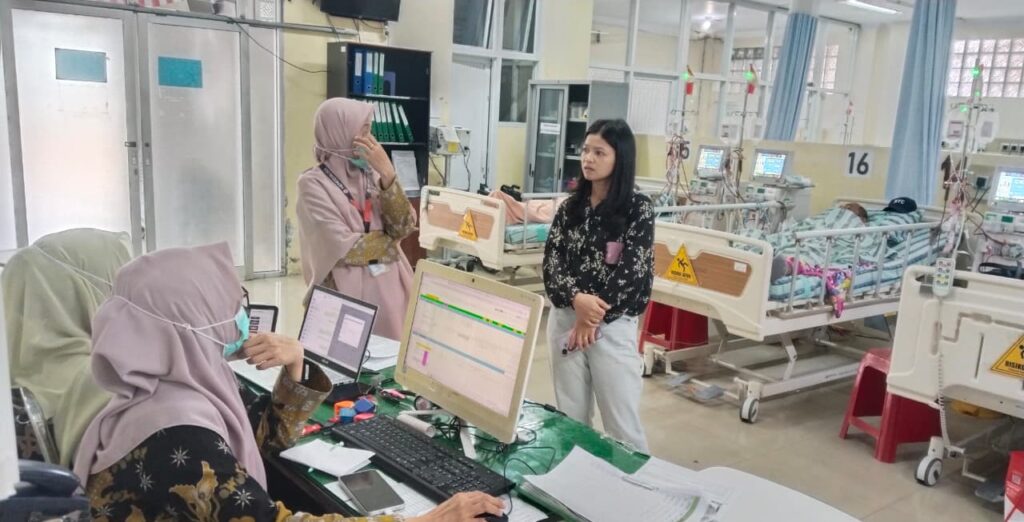
However, observing a patient’s condition is only one part of the nursing process. The information must also be documented appropriately so that other healthcare professionals can understand what happened, what actions were taken, and how the patient responded.
Imagine completing a hemodialysis session after carefully monitoring a patient’s blood pressure, pulse, respiratory rate, and general response to treatment. The procedure may have been completed, and the patient may be preparing to leave the unit. Yet, if the nursing observations and interventions are not documented accurately, important information may be lost when care is handed over to another healthcare professional.
This is why I consider nursing documentation an essential part of patient care rather than a routine administrative task.
My experience in hemodialysis nursing has made me appreciate the importance of recording clinical observations systematically. Documentation helps connect one stage of care to another. It allows the next nurse to understand the patient’s condition and provides a record of the nursing care delivered.
This understanding is closely related to the principles outlined in ANA’s Principles for Nursing Documentation: Guidance for Registered Nurses, published by the American Nurses Association (ANA) in 2010.
The guide explains that nursing documentation supports communication, patient safety, quality improvement, professional accountability, and the continuity of care. It also discusses the characteristics of effective documentation, the importance of organizational policies, information security, documentation entries, and standardized terminology.
In this article, I will review the guidance from beginning to end while reflecting on its relevance to my experience caring for patients undergoing hemodialysis.
The purpose is not simply to summarize a professional document. It is to understand why the principles matter in everyday nursing practice.
Understanding the ANA Nursing Documentation Guidelines
The American Nurses Association developed its documentation guidance to help registered nurses understand the professional expectations associated with recording nursing care.
Although the guide was published in 2010 and reflects the professional and regulatory environment of the United States at that time, its central themes remain relevant to discussions about nursing practice: accuracy, completeness, confidentiality, accountability, and effective communication.
Documentation serves several purposes.
First, it communicates information among members of the healthcare team. Nurses, physicians, and other professionals need reliable information to understand a patient’s condition and coordinate appropriate care.
Second, it supports patient safety. Changes in a patient’s condition, interventions, and responses need to be recorded so that important clinical information is available for subsequent decisions.
Third, documentation provides evidence of the nursing process. It helps demonstrate how nurses assess patients, identify problems, plan care, implement interventions, and evaluate outcomes.
Fourth, documentation supports quality assessment, clinical audits, professional evaluation, research, and administrative processes. Depending on the healthcare system and applicable regulations, records may also be used for reimbursement and legal review.
These functions are closely connected.
In hemodialysis nursing, for example, recording vital signs without documenting relevant clinical observations or the patient’s response may provide an incomplete picture of the care delivered. Similarly, documenting an intervention without recording its outcome may make it difficult for another nurse to determine whether the patient’s condition improved, remained unchanged, or required further evaluation.
For me, this reinforces an important principle: documentation should describe the nursing care provided and the patient’s response, not merely list the procedures performed.
A nursing record becomes more meaningful when it connects assessment findings, clinical decisions, interventions, and evaluations into a coherent account of care.
My Perspective as a Hemodialysis Nurse
Hemodialysis nursing requires attention to the patient’s condition throughout the treatment process. A patient’s clinical status may differ before treatment, during the session, and immediately afterward.
In my practice, I understand the importance of documenting relevant observations at these different stages.
Before treatment, assessment findings help establish the patient’s condition at the beginning of the session. During treatment, ongoing observations and monitoring help the nursing team follow the patient’s response. After treatment, the final assessment and relevant vital signs help describe the patient’s condition at the end of the session.
Blood pressure, pulse, respiratory rate, and the patient’s general response are examples of information that may be important to document, according to the patient’s condition and the unit’s procedures.
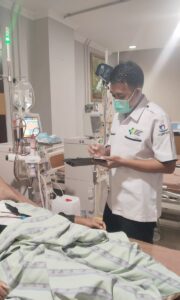
The significance of these observations is not limited to the moment when they are recorded. They may also help other nurses understand the patient’s clinical course and identify changes when comparing information across different assessments.
For example, a nurse reviewing the patient’s record may need to understand the patient’s condition before treatment, the observations made during the session, the interventions performed, and the condition documented after treatment.
If the information is incomplete, unclear, or recorded too late, the continuity of care may be affected.
This does not mean that every nursing note must be unnecessarily long. Instead, the documentation should contain the relevant information needed to understand the patient’s condition and the nursing care provided.
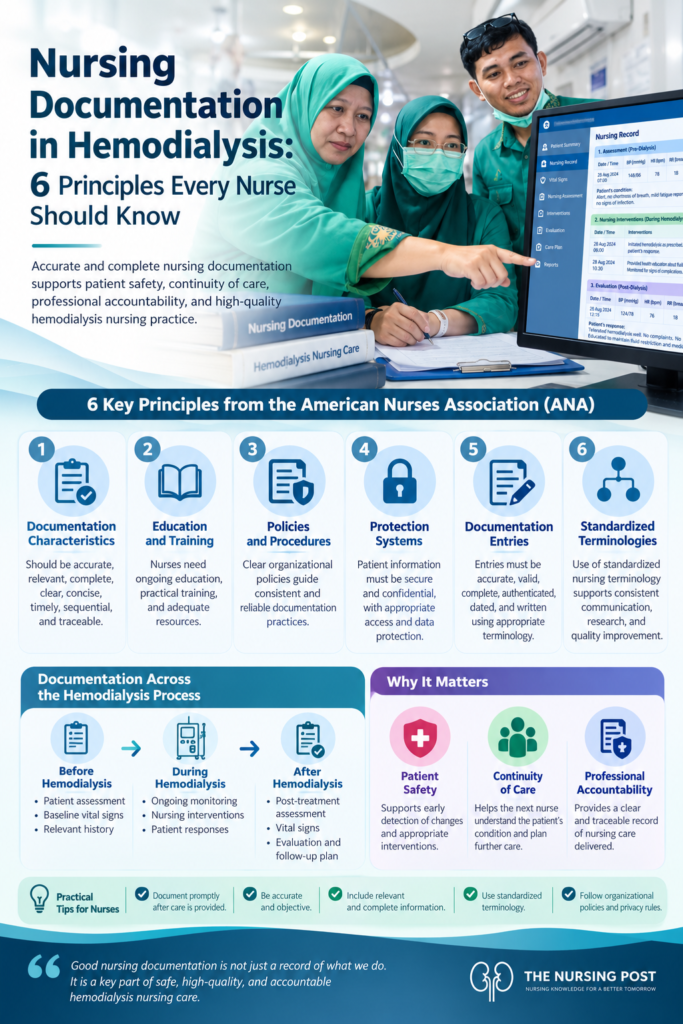
The ANA guide provides a framework for achieving this goal through six major principles.
Principle 1: Documentation Characteristics
The first principle concerns the characteristics that make nursing documentation effective.
According to the ANA guide, documentation should be accessible, accurate, relevant, consistent, auditable, clear, concise, complete, legible, thoughtful, timely, and sequential. It should reflect the nursing process and provide a permanent, traceable record.
These characteristics are interconnected. A record may contain accurate information but still be difficult to use if it is poorly organized or unavailable to authorized professionals who need it.
Accuracy and Completeness in Nursing Records
In hemodialysis nursing, accuracy means recording observations and interventions as they actually occurred. Vital signs should reflect the measurements obtained, while descriptions of the patient’s condition should be based on actual observations and appropriate assessments.
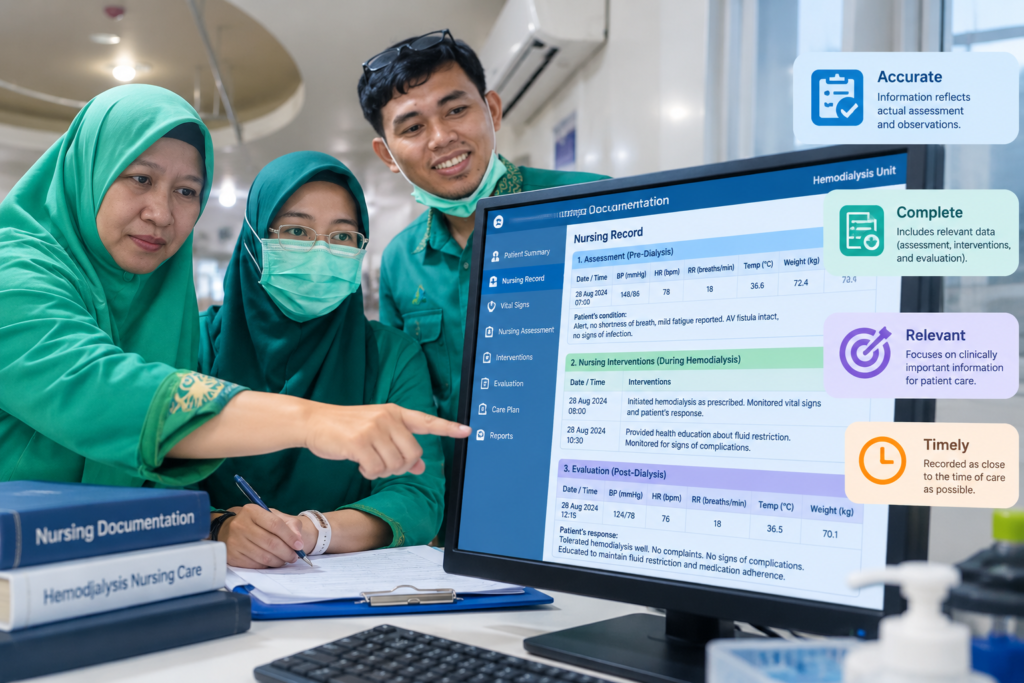
Completeness means documenting the relevant information needed to understand the care provided. A record that contains only a final measurement may not adequately describe the patient’s condition throughout treatment when additional observations or interventions were clinically relevant.
However, completeness should not be confused with writing everything imaginable. Documentation should remain focused on clinically relevant information.
Timely and Clear Clinical Documentation
The timing of documentation also matters.
When nursing observations and interventions are recorded promptly, the information is more likely to accurately represent the sequence of events. Delayed documentation can make it difficult to reconstruct what happened and when it happened.
In a hemodialysis unit, the sequence of assessment, monitoring, intervention, and evaluation can be important for understanding the patient’s clinical course.
For example, a record should allow authorized readers to distinguish the patient’s condition before treatment from observations made during the session and the assessment performed afterward.
Clarity and relevance
Documentation should be understandable to the professionals who use it. Ambiguous expressions, unnecessary abbreviations, and poorly structured notes can create confusion.
Concise documentation is useful when it communicates the necessary information without unnecessary repetition. Nevertheless, brevity should never come at the expense of clinical meaning.
The record should also be auditable and traceable. Entries need to preserve the integrity of the clinical record and make it possible to determine the source and timing of documented information in accordance with the applicable system.
From my perspective as a hemodialysis nurse, these characteristics help transform routine observations into information that can support continuity of care.
The first principle reminds me that good documentation is not measured by the number of words written, but by the accuracy, relevance, clarity, and usefulness of the information recorded.
Principle 2: Education and Training
The second principle addresses the education and training required to document nursing care effectively.
Documentation systems can vary considerably between healthcare organizations. Some facilities rely primarily on paper records, while others use electronic health records (EHRs) or a combination of digital and paper-based systems.
Regardless of the format, nurses need to understand how to document care correctly and how to use the systems available in their workplace.
Training may involve learning how to enter information, select appropriate documentation fields, use standardized terminology, authenticate entries, correct errors according to established procedures, and protect confidential information.
When electronic systems are used, nurses may also need training in the relevant hardware, software, and procedures for handling technical problems.
The ANA guide recognizes that effective documentation requires more than individual competence. Nurses also need adequate resources and sufficient time to complete documentation appropriately.
This point is important because documentation takes place within a broader clinical environment. Nurses must balance record-keeping with direct patient care, ongoing observation, communication, and other professional responsibilities.
In hemodialysis units, documentation must be integrated into the workflow without compromising patient monitoring or other essential nursing activities.
Education and training should therefore be ongoing rather than limited to initial orientation. Changes in documentation systems, professional standards, organizational policies, or clinical workflows may create new learning needs.
For me, this principle highlights the relationship between professional competence and documentation quality. A nurse may understand the patient’s condition but still encounter difficulties if the documentation system is unfamiliar or the required procedures are unclear.
Healthcare organizations should provide appropriate training, clear instructions, accessible support, and opportunities to improve documentation skills.
At the same time, nurses have a professional responsibility to understand the documentation requirements relevant to their practice.
Principle 3: Policies and Procedures
The third principle focuses on the policies and procedures that guide nursing documentation within healthcare organizations.
Professional expectations need to be translated into practical instructions that nurses can follow consistently.
Organizational policies may address what information must be documented, when entries should be made, how records are authenticated, how errors are corrected, and how information is shared among authorized healthcare professionals.
Policies should also explain the appropriate use of documentation systems and define responsibilities for maintaining the integrity of the clinical record.
One important issue addressed in the ANA guide is system downtime.
Electronic documentation systems may become temporarily unavailable because of technical failures, maintenance, or other disruptions. Healthcare organizations need procedures that explain how patient care information should be recorded during these periods and how the information should be managed when the system becomes available again.
Without clear downtime procedures, important information may be omitted, recorded inconsistently, or become difficult to retrieve.
In a hemodialysis unit, documentation must remain reliable even when the usual recording system cannot be accessed. The exact process will depend on the organization’s approved procedures, but staff should understand what to do before a disruption occurs.
Policies also help reduce variation in documentation practices. When different nurses follow different methods for recording similar information, interpreting the record and comparing patient data may become more difficult.
Consistent procedures can help establish shared expectations across shifts and clinical teams.
However, policies should not remain static documents that staff rarely consult. They should be accessible, understandable, reviewed when necessary, and supported by education.
The ANA guide is particularly useful here because it connects documentation quality with the responsibilities of the organization, not only those of individual nurses.
Accurate documentation depends on both the nurse’s professional judgment and the system in which that nurse works.
For Indonesian healthcare facilities, these principles should be applied alongside applicable Indonesian laws and regulations, professional nursing standards, medical-record requirements, and institutional policies. The ANA guide is a professional reference, not a replacement for local legal requirements.
Principle 4: Protection Systems and Patient Confidentiality
The fourth principle concerns systems for protecting information.
Nursing documentation contains information about patients’ health, assessments, treatments, and responses to care. Such information must be handled responsibly.
The ANA guide discusses the protection of patient identification, patient confidentiality, healthcare personnel confidentiality, and organizational confidentiality.
These concerns become especially important as healthcare information is stored, accessed, and shared through electronic systems.
Patient confidentiality
Patient information should only be accessed, used, or disclosed in accordance with applicable laws, professional responsibilities, and authorized purposes.
Nurses should avoid discussing identifiable patient information in inappropriate settings or sharing records with individuals who do not have the necessary authorization.
Confidentiality also applies to everyday communication. Clinical information should be shared with the appropriate people through appropriate channels.
Information security
Electronic records may require authentication, access controls, secure devices, and other protective measures. Staff should follow organizational procedures for logging in, accessing records, and protecting information from unauthorized disclosure.
Passwords and authentication credentials should not be shared in ways that undermine security. Nurses should also follow policies governing the use of personal devices, printing, downloading, or transferring clinical information.
The appropriate safeguards depend on the systems used and the applicable legal and organizational requirements.
Confidentiality in hemodialysis care
Patients receiving hemodialysis may attend treatment regularly and develop ongoing relationships with members of the healthcare team. Familiarity with a patient does not remove the responsibility to protect that person’s privacy.
Clinical information should remain confidential even when nurses recognize patients outside the clinical setting or communicate with colleagues who are not involved in their care.
Documentation must also be factual and professional. Records should focus on relevant clinical information rather than personal judgments or unnecessary details.
The ANA guide places information protection within the broader responsibility of professional nursing practice.
For me, this principle reinforces the idea that good documentation must meet two requirements: the information must be available to authorized professionals who need it for care, and it must remain protected from inappropriate access or disclosure.
Accessibility and confidentiality are not opposing goals. A well-designed system should support both.
Principle 5: Accurate and Complete Documentation Entries
The fifth principle addresses the quality and integrity of individual documentation entries.
The ANA guide emphasizes that entries should be accurate, valid, complete, authenticated, dated and timed, legible, and consistent with appropriate terminology and organizational rules for abbreviations and symbols.
This principle brings the discussion from the overall design of documentation to the actual information recorded in the clinical record.
Accurate and valid entries
A nursing entry should reflect what was assessed, observed, performed, or reported. Nurses should distinguish between direct observations, information reported by the patient, and information obtained from other sources when that distinction is clinically relevant.
Documentation should not contain unsupported assumptions presented as established facts.
In hemodialysis practice, recording a patient’s measured vital signs is different from making a general statement about the patient’s condition. Both observations and interpretations may be relevant, but they should be documented in a manner that preserves their meaning.
Date, time, and authentication
Entries should be dated, timed, and authenticated according to the applicable system and institutional policy.
These details help establish when the information was recorded and who was responsible for the entry. They are important for understanding the sequence of care and maintaining accountability.
Electronic systems may have specific requirements for authentication, late entries, amendments, or corrections. Nurses should follow the approved procedures rather than altering records in ways that compromise their integrity.
Legibility and terminology
Documentation should be legible and understandable. In electronic records, legibility may be less of a concern than in handwritten notes, but unclear language and inappropriate abbreviations can still create problems.
Standardized terminology and approved abbreviations help reduce ambiguity. If an abbreviation is unfamiliar or used differently across departments, it may lead to misunderstandings.
This is especially relevant in clinical environments where several healthcare professionals rely on the same record.
Documentation as professional evidence
The nursing record provides evidence of care delivered and decisions made. It should therefore be prepared with the same care that nurses apply to other professional responsibilities.
A record should not be treated as an opportunity to assign blame or create a misleading account of events. It should provide a factual, clinically relevant description of the patient’s condition and the care provided.
In my work with hemodialysis patients, this principle reinforces the importance of documenting assessments, interventions, and patient responses in a clear and traceable manner.
The record should enable another authorized professional to understand the relevant clinical information without having to guess what the original nurse intended.
Principle 6: Standardized Nursing Terminologies
The sixth principle focuses on standardized terminology in nursing documentation.
Nurses may use different words to describe similar observations or interventions. Without shared terminology, it can become difficult to compare information across patients, shifts, departments, and healthcare organizations.
Standardized terminology provides a more consistent way to describe nursing assessments, diagnoses, interventions, outcomes, and evaluations.
This consistency supports communication and can improve the usefulness of nursing data for clinical review, quality improvement, research, and health information systems.
Connecting the nursing process
Nursing documentation should reflect the relationships among assessment, nursing diagnosis, planning, intervention, and evaluation.
When terminology is used consistently across these stages, the record can provide a clearer account of the nursing process.
For example, the information documented during assessment should be relevant to the identified nursing problems. The interventions should relate to the plan of care, and the evaluation should describe the patient’s response or the outcome of the intervention.
This does not mean that every patient’s record should look identical. Patients have different needs, and documentation must reflect individual clinical circumstances.
Standardization creates consistency in how information is expressed without removing the need for individualized care.
Supporting data analysis and quality improvement
Consistent terminology also helps organizations analyze nursing data.
When similar clinical concepts are documented in comparable ways, it becomes easier to review patterns, evaluate processes, and identify opportunities for improvement.
Standardized data may support nursing-sensitive indicators, clinical research, quality measurement, and the development of more effective care practices.
In hemodialysis nursing, structured and consistent documentation can help the healthcare team review patient assessments, interventions, and outcomes over time. The value of such review depends on the quality of the underlying records and the appropriateness of the data collected.
The ANA guide also places standardized terminology within the wider development of health information systems and nursing informatics.
As electronic health records become more sophisticated, consistent terminology can help information move between systems and remain meaningful to the professionals who use it. The extent of that interoperability depends on the standards and technologies implemented.
For me, the key lesson is that documentation is not simply a collection of separate notes. It is a structured source of clinical information that can support patient care, professional communication, and the evaluation of nursing practice.
Recommendations for Nurses and Healthcare Organizations
Beyond the six principles, the ANA guide discusses recommendations for different groups involved in nursing documentation.
These recommendations recognize that documentation quality is a shared responsibility. Nurses play a central role, but they do not work in isolation.
Recommendations for nurses
Nurses should understand the professional standards and organizational policies governing documentation in their practice.
They should record care accurately, maintain confidentiality, use appropriate terminology, and ensure that entries reflect the nursing process.
Nurses should also participate in relevant education and training and seek clarification when documentation requirements are unclear.
In hemodialysis practice, this means treating documentation as part of the care process rather than a task to be completed without considering its clinical purpose.
Recommendations for employers and healthcare organizations
Healthcare organizations should establish clear documentation policies and provide appropriate systems, resources, and training.
They should ensure that staff understand their responsibilities and have access to the tools needed to record care accurately.
Organizations should also maintain safeguards for information security and develop procedures for situations in which normal documentation systems become unavailable.
Documentation systems should support clinical work rather than introduce unnecessary barriers to effective care.
Recommendations for nursing education
Nursing education should prepare students to understand documentation as a professional and clinical responsibility.
Students need opportunities to learn how documentation supports communication, clinical reasoning, patient safety, and accountability.
Training should also address confidentiality, ethical responsibilities, standardized terminology, and the appropriate use of electronic documentation systems.
These skills are relevant throughout a nurse’s career, not only during initial education.
Recommendations for research
Research can help improve understanding of documentation practices, their effects on healthcare delivery, and the ways technology influences nursing work.
Further evaluation can identify barriers to effective documentation and opportunities to improve usability, consistency, and quality.
Research is also important for determining how documentation systems can support better clinical communication without creating unnecessary administrative burdens.
Recommendations for patients and consumers
Patients have an interest in understanding how their health information is documented and protected.
Clear communication about the use of health information can help patients understand their rights and responsibilities under the applicable rules.
Healthcare organizations should provide information that is appropriate to their legal obligations and the needs of the people they serve.
These recommendations demonstrate that effective documentation requires collaboration among nurses, employers, educators, researchers, patients, and the wider healthcare system.
The Glossary: Understanding the Language of Documentation
The ANA guide includes a glossary to clarify important terms used in discussions of nursing documentation.
This section is valuable because documentation involves clinical, legal, ethical, and technological concepts that may have specific meanings.
Terms associated with electronic health records, evidence-based practice, privacy, confidentiality, protected health information, nursing-sensitive indicators, the plan of care, and telehealth help explain the broader environment in which nursing records are created and used.
For nurses, understanding these terms is more than an academic exercise.
A clear understanding of privacy and confidentiality, for example, helps guide decisions about how patient information should be accessed and shared. Familiarity with electronic health records supports the appropriate use of digital systems. Understanding nursing-sensitive indicators helps explain how nursing-related information may contribute to quality measurement.
The glossary also provides a common vocabulary for readers who may have different professional backgrounds.
However, terminology and legal definitions can change over time. Some terms in the 2010 guide reflect the United States healthcare environment and its regulatory framework. Indonesian nurses should interpret those terms in context and consult current Indonesian laws, professional standards, and institutional policies when applying them to local practice.
References and Contributors: The Professional Foundation of the Guide
The reference section and contributor information provide additional context for understanding the guide.
The document draws on professional standards, ethical guidance, and literature concerning nursing practice, electronic documentation, confidentiality, health information, and nursing informatics.
These sources demonstrate that nursing documentation is connected to broader professional responsibilities. It is not an isolated administrative activity but part of a framework involving ethics, clinical standards, information management, and accountability.
The contributors listed in the guide also reflect the professional work involved in developing documentation guidance.
For readers, these sections are useful starting points for further study. Nurses, educators, researchers, and healthcare leaders can consult the cited materials to explore specific issues in greater depth.
Because the guide was published in 2010, readers should also consider whether newer professional standards, technologies, or legal requirements have changed the context in which particular recommendations should be applied.
The enduring value of the document lies in its systematic treatment of documentation as a professional responsibility, while its age reminds readers of the need to verify current requirements.
Applying ANA Principles to Hemodialysis Nursing
After reviewing the guide, I return to the clinical environment where documentation becomes part of everyday nursing practice.
In hemodialysis care, nurses assess patients, monitor their condition, implement appropriate interventions, communicate with the healthcare team, and evaluate responses to treatment.
Documentation connects these activities.
The six principles provide a useful framework for examining whether nursing records are accurate, complete, timely, secure, consistent, and meaningful.
The first principle reminds me to ensure that the record communicates the relevant clinical picture. The second highlights the importance of training and resources. The third emphasizes clear policies and procedures. The fourth reinforces confidentiality and information security. The fifth focuses on the integrity of each entry. The sixth demonstrates why standardized terminology matters.
Together, these principles help explain how documentation can support continuity of care and professional accountability.
They also encourage nurses to consider the record from the perspective of the next person who needs to use it.
Can another authorized nurse understand the patient’s condition from the information recorded? Are the relevant assessments and interventions documented? Is the sequence of care clear? Does the record describe the patient’s response when that information is clinically relevant? Has confidential information been protected?
These questions can help nurses evaluate their documentation practices.
They are not intended to replace clinical judgment, local policies, or professional standards. Rather, they provide a structured way to think about the quality and purpose of nursing records.
For Indonesian nurses, the ANA guide can serve as a professional learning resource. Its recommendations should be interpreted alongside Indonesian regulations governing medical records, patient privacy, professional nursing practice, and the policies of the healthcare facility.
Conclusion: Better Documentation, Safer Nursing Care
My experience caring for patients undergoing hemodialysis has strengthened my understanding that nursing documentation is an essential part of professional care.
Assessing a patient’s condition, monitoring vital signs, observing responses to treatment, and recording relevant findings are connected activities. Documentation helps preserve information from these activities so that it can be understood and used appropriately by other members of the healthcare team.
The ANA guide provides a structured explanation of this responsibility through six principles: documentation characteristics, education and training, policies and procedures, protection systems, documentation entries, and standardized terminologies.
Its broader discussion of recommendations, terminology, references, and contributors further demonstrates that effective documentation depends on individual nursing competence, organizational support, education, and professional standards.
For me, the central lesson is straightforward: nursing documentation is not merely a record of what has been done. It is a professional account of the care provided, the information observed, and the patient’s response.
A well-prepared nursing record can support communication, continuity of care, quality improvement, and accountability. An incomplete or unclear record can make it more difficult for others to understand what happened and determine what information may be needed next.
Every entry therefore deserves attention.
When I document nursing care in the hemodialysis unit, I am not simply completing a form or filling in a field on a computer. I am contributing to the clinical information that helps the healthcare team understand the patient’s condition and coordinate care.
That is why the principles presented in ANA’s Principles for Nursing Documentation: Guidance for Registered Nurses remain valuable for professional reflection and continuing education.
The document was published in 2010, but its central message continues to prompt an important question for nurses: Are we documenting merely to complete a requirement, or are we documenting to support safe, consistent, and accountable nursing care?
The answer should guide the way we write every nursing note.